
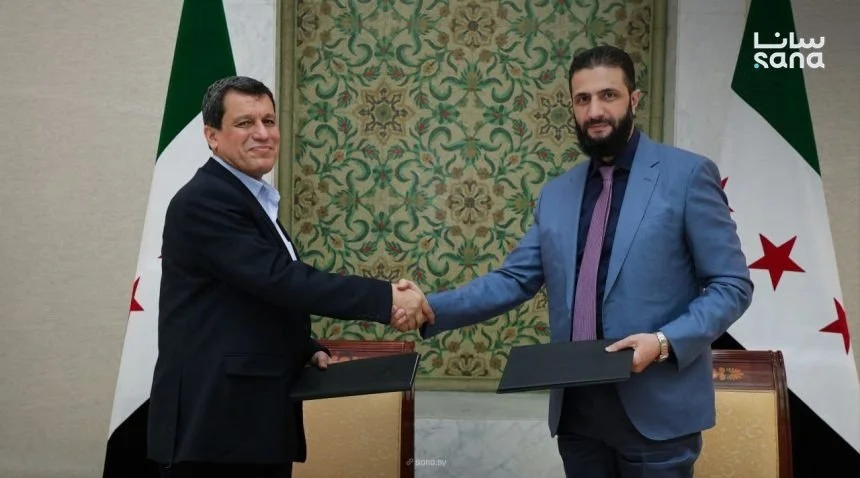
President al-Sharaa shakes hands with former SDF commander, Mazloum Abdi, after announcing the integration of SDF into government forces, August 2026. Photo Source
The majority of civil wars that break out today are resurgences of past conflicts, and many political scientists highlight government policy as the main determinant of whether or not peace lasts. The task of forging long-lasting stability is especially fraught for the transitional government of Ahmed al-Sharaa in Syria. The government came to power in December 2024, when rebel forces overthrew President Bashar al-Assad after over 50 years of totalitarian rule, ending 13 years of civil war. The war was extremely brutal, resulting in a minimum of 350,000 deaths in its first 10 years, including well over 50,000 women and children according to UN estimates.
Much of the fighting was organised along sectarian lines, meaning a failure by al-Sharaa’s Sunni-led government to manage still-armed minority groups could be disastrous. The violence involving Alawi and Druze communities in 2025 and the government’s subsequent policy responses reveal early failures of al-Sharaa’s transitional government in minority relations. However, more recent political settlements with the Kurds may present a policy blueprint for disarmament and meaningful government integration. The transitional government must also navigate foreign intervention and competing strategic interests, complicating its efforts to consolidate authority and integrate minority communities. As the transition to civilian rule progresses amid ongoing sectarian violence, how promising is the possibility of sustainable peace in Syria?
In March 2025, only four months after taking power, security forces and their allies killed over 1,400 Alawi civilians in a government operation to quell a pro-Assad insurgency along the Mediterranean coast. As the newly formed army marched on communities belonging to the same religious sect as the former president, the operation resulted in mass graves, countless reports of torture, and entire communities destroyed. While the government officially called for the protection of civilians, the security forces failed to take sufficient action to prevent further civilian targeting once the killings had begun. Though there were some instances of government-led civilian evacuations, other officials used graphic imagery to describe the operation’s plan, potentially encouraging abuses. As a policy response, a government commission was formed to investigate the events, drawing on over 1,000 testimonies from officers and civilians, with a current list of 298 suspected of civilian violence and disobeying military orders. However, the commission already faces criticism from victims who say it is targeting scapegoats rather than leaders, and that the investigation has been rushed, biased, and performative. Reuters’ investigation suggests that these atrocities may have been driven partly by a desire for revenge against communities perceived as aligned with the Assad regime. They may reflect a failure by al-Sharaa to ensure that the newly formed army, composed of former militants, adheres to his proclaimed vision of civil peace. Furthermore, the government risks setting a dangerous precedent of impunity and injustice if its policy response is too weak.
The government’s July 2025 interventions in the Druze-controlled Suwayda governorate also resulted in reports of civilian killings and forced displacement, though reportedly on a smaller scale than that of the coastal Alawi massacres. Israeli air strikes have undermined government control in Suwayda, which Israel has justified with a desire to protect the Druze minority from the Syrian government. However, military action also reflects broader strategic ambitions, including maintaining control over the disputed Golan Heights region and eliminating Syrian military presence near its border. In response, al-Sharaa vowed that anyone suspected of crimes in Suwayda would be held accountable, but this remains to be seen. Although the Minister of Defence issued a Military Code of Conduct following the coastal Alawi massacres, authorities likely still had not crystallised a hierarchical command chain over the security force, unsurprising considering its newness, combined with the lack of a functioning judicial apparatus, and a possible persistence of a guerrilla mentality among some members. It is impossible to determine whether or not sectarian human rights abuses will decrease in the long term, though the government is announcing policy measures to professionalise its military. For now, al-Sharaa has appointed one Druze member to Syria’s People’s Assembly, although the remaining seats allocated to Suwayda governorate remain empty due to postponed elections. Meaningful integration of Druze communities may therefore require the Syrian government to pursue negotiated political and security arrangements beyond military coercion with the Druze and with the Israeli government, considering the Israeli position and continued military support.
Recent negotiations between the transitional government and the Kurdish-led Syrian Democratic Forces (SDF) may provide a blueprint for minority integration. Following a year of failed negotiations over national unification, the Syrian armed forces launched an offensive into SDF-controlled territory in northeastern Syria in January 2026. Within two days, the Syrian army took control of 80% of SDF-controlled territory, and 65–70% of its forces defected, forcing the SDF into a position of capitulation in negotiations. The agreement resulted in the dissolution of the SDF and the relinquishing of control over the SDF’s remaining territory in northern Syria. In return, al-Sharaa’s government agreed to integrate SDF fighters into the national armed forces, in effect as of August 2026, and to grant Kurds greater rights, restoring their citizenship rights, declaring Kurdish a national language, and promising the right to Kurdish-language education in northern schools. Several high-ranking SDF officials were given positions in the transitional government, including the former commander, who was appointed as a presidential advisor. Twelve Kurdish representatives currently hold seats in the People’s Assembly, including three who were appointed directly by al-Sharaa, the rest of whom were elected in the northeastern provinces in May. Although the agreement offers a potential model for minority integration, the military pressure under which it was negotiated raises questions about whether or not it will result in genuine inclusive governance, especially as the implementation of certain promised cultural and political rights remains in progress.
The difference in the treatment of the Kurds versus other minority groups may be linked to their larger territorial holdings, as well as a desire to build favourable relations with foreign partners. Most notably, Turkey has recently been pushing for SDF integration, while the United States was a long-standing ally to the group until January of 2026, when it withdrew support, instead favouring the SDF’s dissolution. The efforts made by the Syrian government in negotiating integration may therefore be linked to building partnerships in other areas of international policy. Furthermore, the conflict with the SDF also differs from other cases because both parties seemed reluctant to engage in prolonged fighting, especially due to American influence, and the SDF quickly accepted a ceasefire when proposed. This may also facilitate integration efforts, as it limits additional hostility from getting in the way of negotiation. In contrast, Alawis lack significant foreign support following Iran’s withdrawal from Syria, and their lack of a territorial stronghold, military strength, and central organisation following the fall of Assad, combined with existing hostility from their association with the former regime, may explain why the March 2025 violence has thus far gone relatively unpunished. Despite the integration of seven Alawis into the Peoples’ Assembly, two of whom were appointed by al-Sharaa, meaningful integration for the Alawi minority seems relatively unlikely given their lack of leverage or external support. Meanwhile, with regard to the Druze, it is unclear whether or not Israeli interference would work in their favour for negotiations. On one hand, a strong foreign backer could improve the Druze’s negotiating power, especially as this issue was used as a talking point in Israel’s recent election. On the other hand, it obstructs the establishment of peace in Suwayda, and may pose additional barriers to integration by fueling rhetoric that the Druze endorse Israeli support – although with continued human rights violations on the part of the Syrian state, this idea may be gaining popularity.
If al-Sharaa truly hopes to form a stable, peaceful state, it is imperative that he weaken sectarian divides in favour of a unified national identity. However, failures in unifying the state in 2025 seem to illustrate a tendency to favour military coercion as a strategy rather than the politics of peace and inclusion which al-Sharaa promotes officially. And while it is impossible to say whether or not violence against minority groups received unofficial government support, it is clear that efforts in preventing and investigating the massacres have been dangerously insufficient. Policy responses to the atrocities committed by security forces in the coastal region and in Suwayda must go beyond acknowledgements and the prosecution of a few, presumably low-level soldiers. Issuing a military code of conduct may be an important step, alongside al-Sharaa’s policy that all armed groups must integrate into the army. The integration of minority sects in the army may be an important way to reduce the incidence of sectarian violence, as research shows that military inclusivity reduces the risk of atrocities committed. However, this is only true if different groups stand on equal footing within the military, which remains to be seen as Kurdish integration progresses. For example, the government has thus far refused to allow the all-female Women's Protection Units of the SDF to integrate into the Syrian armed forces, instead proposing that they join the tourism police, an ongoing point of tension. Lastly, securing a ceasefire with Israel is critical to calming tensions in Suwayda, which may be a necessary precursor to integration policy with the Druze community. Kurdish integration appears to have been sparked by a decrease in support from the US, yet the Druze’s foreign support does not appear to be diminishing. This could mean that the Druze will be better positioned to make greater demands to the Syrian state if such a negotiation process occurs.
In short, by professionalising its military, delivering significant justice to the victims of the 2025 sectarian massacres, and securing a ceasefire with Israel in the southern provinces, Syria’s transitional government could make substantial progress toward weakening sectarian divides. Though minority integration alone cannot guarantee peace, a failure in this regard could significantly increase the risk of renewed large-scale conflict.
Edited by Ella Farivar