
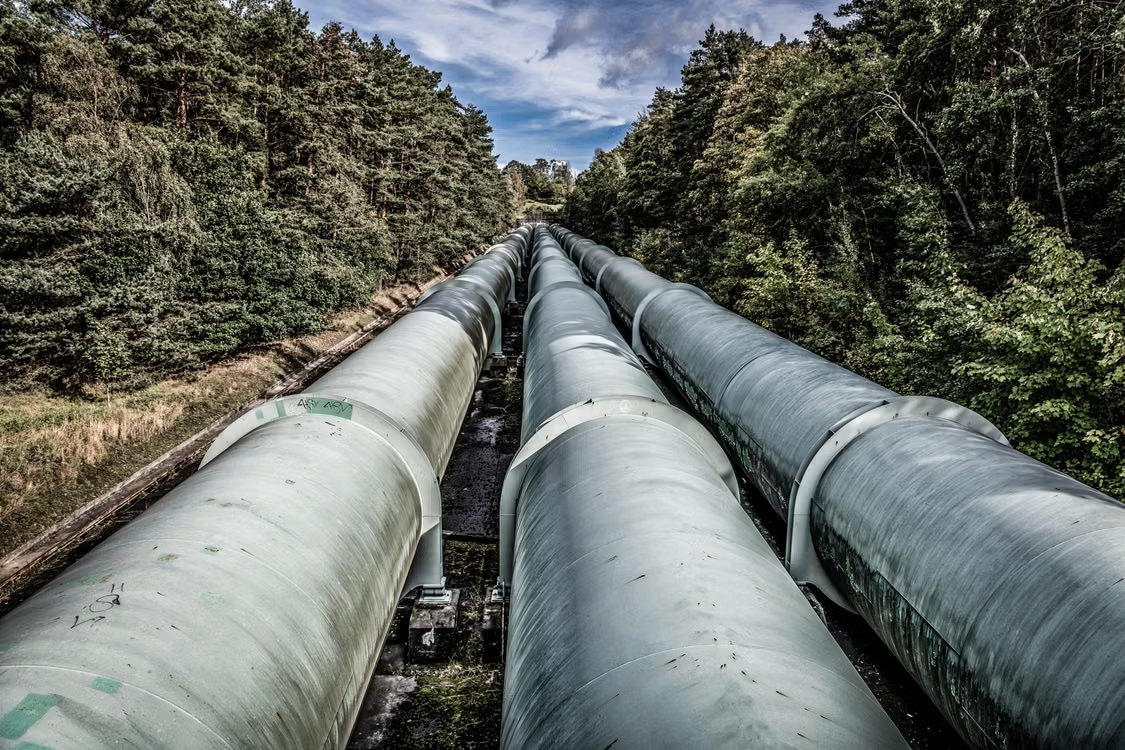
If you follow almost any high-voltage line out of Manitoba or Quebec, you’ll find it points south. Canada’s disconnected provincial energy grids were built towards American cities, where the customers, money, and industries are. For over 170 years, similar logic shaped much of the country’s trade, from railroads and oil pipelines to automotive supply chains. Then, in November 2024, President Donald Trump threatened Canada with 25% tariffs under the guise of a war on drugs. At first, some conjectured that because the relationship was symbiotic, it would amount to nothing more than empty threats. However, it played out more like the Oasis breakup of 2009, abruptly ending an era of fruitful collaboration. Tariffs took effect in March 2025, a trade war followed, and in April that same year, Mark Carney and the Liberals swept the federal elections on a promise to reduce the Canadian economy’s dependence on the US.
In light of deteriorating cross-border relationships, the obvious answer was to trade with ourselves. To this end, the One Canadian Economy Act slashes interprovincial trade barriers. But opening up trade isn’t enough if Canada is lacking goods, markets, and transportation systems. Economists at CIBC argue that the real barriers are distance and market size: Canada is a vast territory with a comparatively small population, strung along the US border, whose infrastructure was never built to connect east to west. The Building Canada Act (BCA), and its September 2026 Building Canada Strong amendment, target this physical constraint by fast-tracking major infrastructure and resource projects. Speed is a valid goal. The question is, what are we compromising by accelerating projects?
The Building Canada Act, passed last year with Conservative support as the second part of Bill C-5, works like a VIP line with a single bouncer: the Cabinet. On recommendation from a minister, the Cabinet can add a project to the official “project of national interest” (PONI) registry of the BCA. To designate a project as a PONI, the Cabinet must give 30 days' public notice in addition to conducting what it considers an adequate consultation with provinces and concerned Indigenous rights holders. However, the decision criteria are loose. While the evaluation proposes relevant factors the Cabinet may consider, the list is a suggestion at best, as the legislation does not set a minimum standard projects must meet. Through this process, not only does assessment under environmental protections like the Impact Assessment Act, Fisheries Act, and Species at Risk Act get streamlined, but they are no longer asking whether a project should be built, but how. Furthermore, under section 22 of the BCA, the Cabinet could even exempt PONIs from certain federal laws while bypassing a standard parliamentary vote. For instance, the first project listed was the West Coast Oil Pipeline (Pacific Link), which will span about 1250km and carry an estimated million barrels of crude a day from Alberta to British Columbia, which works directly against national emission targets.
When the Building Canada Act was first passed in 2025, the extensive powers it granted the Cabinet were framed as a temporary measure. It came with a five-year expiry date via its “sunset clause,” which kept a semblance of democratic balance. However, the new amendment, Bill C-39, known as the Building Canada Strong Act, is currently undergoing review before Parliament, and it erodes these constraints. Most importantly, it removes the original Act’s sunset clause, making it permanent. The current government may have Canadians’ trust, but removing the sunset clause means these powers will outlast it and will potentially extend to future governments. The Bill also posits that for a minister to attach an environmental protection condition to any project permit (not just PONIs), they must consider its technical, economic, and practical feasibility rather than basing their decision solely on environmental impact. In addition, it allows the Minister of One Canadian Economy and the Minister of Environment (MOE) to adjust environmental conditions after the fact. Currently, the MOE may modify project conditions “if they do not increase the extent to which the effects are adverse,” which would be changed to “if they determine the amendment to be in the public interest." This change legitimizes decisions found to increase adverse effects, replacing the original explicit boundary with the much vaguer concept of “public interest.” To add icing on the cake, or bulldozers in our forests, C-39 would allow projects to commence preparations before a final decision statement on the impact assessment is issued. These changes together represent a license to negotiate away existing environmental protections that were developed by experts over decades, indefinitely.
There is also the question of how Bill C-39 affects Indigenous consultation requirements. Frequently, Indigenous communities are most personally affected, and often framed as an obstacle to development. While the Act still technically requires Indigenous consultation, First Nations leaders and advocates have raised concerns about certain provisions. Time constraints and streamlining of project approvals further undermine already unsatisfactory consultation systems. Meaningfully adhering to the Common Law Duty to Consult through the Free, Prior, and Informed Consent framework (from the United Nations’ Declaration on the Rights of Indigenous Peoples) can be a long and intensive process, as the subject usually involves fragile environmental and social systems. Indigenous participation in decision-making concerning their lands has been long fought for and is constitutionally protected, but only to a certain extent in practice. Often, participation is implemented through mechanisms within impact assessments, so condensing and streamlining these raises concerns about minimizing consultation.
Since this legislation is so new, its physical effects are only projections. To understand why haphazardly streamlining infrastructure projects might erase the mechanisms that allow us to understand if they are worth building in the first place, we can turn to the controversy surrounding the West Coast Oil Pipeline. On the one hand, conservationists raise concerns about threats to marine life, the dangers of fossil fuel infrastructure, and the implications of growing reliance on the oil and gas industry despite Canadian climate targets and the Building Canada Act’s own self-proclaimed “clean growth" and “climate change” orientation. According to CBC, some affected First Nations groups, like the Sumas First Nation, oppose the project on the grounds of environmental concerns over their territory, feeling the consultation process was not inclusive. The report also found that community leaders along the proposed route differ in opinions, illustrating the complexity of consultation – not all Indigenous communities have the same interests and must not be treated as if they do. Meanwhile, the BC business community and resource advocates argue that we need nation-building projects that will create jobs and get resources to more markets. Yet, the Institute for Energy Economics and Financial Analysis (IEEFA) criticized the project as economically unnecessary and unprofitable, emphasizing massive public-sector financial exposure. A Reuters analysis even warns that pipelines create more temporary construction than permanent long-term jobs. This case illustrates one thing: that these projects are too impactful and complex for a Cabinet-led, streamlined approval process.
Indeed, Oxford Economics predicted in 2024 that the US 25% blanket tariffs would quickly send the Canadian economy into a deep recession. It turns out, the economy was not devastated to the extent predicted, and is now recovering from the technical recession of 2025 and early 2026. Meanwhile, the country is warming at twice the global rate and experiencing unprecedented fire seasons. By dismantling decades of legislative, provincial, and Indigenous oversight for the sake of speedy development, the Building Canada Act and its new amendment make heavy sacrifices. If these projects are investments in Canada’s economic future, shouldn’t the government also ensure they are not a threat to Canada’s material future? Climate change is predicted to increase floods, forest fires, epidemics, disrupt agriculture, and displace communities; all of which are threats to the economy as well. Acting in the public interest is not always about determining which crisis is more pressing; maybe in this case it’s about considering both, and that can’t be done while backsliding environmental legislation. We can build a strong, independent Canadian economy, but the Earth doesn’t care about trade wars, and if we destroy it, there’s nowhere else to go.
Edited by Ana Rains