

If there is one generation that grew up with few restrictions on the Internet – and, by extension, on social media – it is Generation Z (1995–2012). The rise of social media has profoundly affected this generation, with unprecedented consequences. In light of this fact, it is more urgent than ever to protect the next generation from these risks. Quebec must establish a true "digital majority" at age 14, as proposed by a National Assembly special commission in 2025 in its 42nd recommendation, and implement an age-verification mechanism through app stores to enforce the law.
The Harmful Effects of Social Media on Young People
Social media arrived extremely quickly: within a few years, these platforms went from a few million users to billions. Meanwhile, legislation and our understanding of their effects have been unable to keep pace. As a result, children today have far too much access to social media, while research showing its harmful effects on them is becoming increasingly hard to ignore.
Indeed, in recent years, a growing body of research has shown the link between mental health problems, in particular, and early and excessive social media use. Leading medical authorities, such as U.S. Surgeon General Vivek Murthy, have issued statements warning the general public of the risks and calling on all actors in society to mobilize in the face of this public health problem.
Table 1: List of Consequences caused by social media usage in children and adolescents, according to the U.S. Surgeon General, 2023
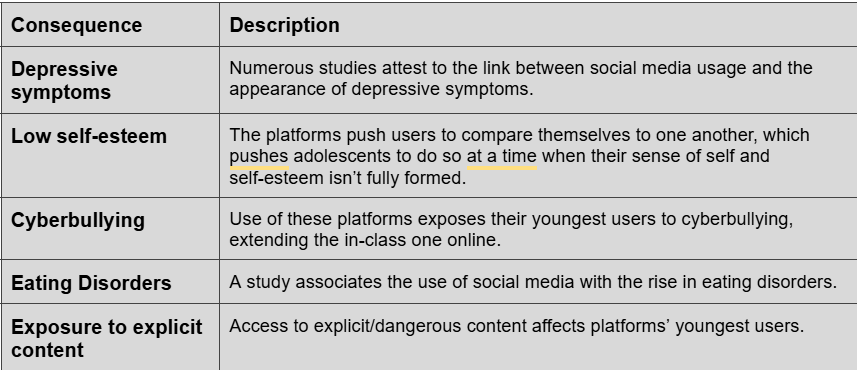
U.S. Surgeon General. (2023). Social Media and Youth Mental Health: The U.S. Surgeon General’s Advisory. U.S. Department of Health and Human Services
Given these potential risks, it is essential to implement adequate protective measures to limit children's exposure to social media as much as possible.
Comparing Methods for Restricting Minors' Access to Social Media
Many governments worldwide have taken up this urgent issue and sought to adopt measures to address it. These measures all converge on one goal: protecting children and young adolescents from the risks these platforms pose. At least 15 countries have acted: 7 have passed laws, and 8 more have bills under way, alongside several U.S. states. The table below sorts the measures adopted or under consideration by who bears responsibility for protecting the child. It groups them into self-declaration, the platform, and finally the app store. These are the three main layers where action is possible.
Table 2: Approaches to age verification, by who bears responsibility
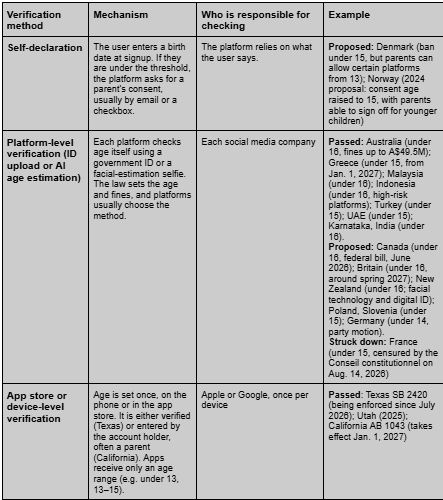
Sources: Reuters, CTV News, LCP, Texas Public Radio, Deseret News, Kelley Drye.
Because these mechanisms have been implemented very recently, and some are not yet fully in effect, it is difficult to compare their effectiveness. Nevertheless, we can already draw a few conclusions from these different methods.
The first method, which has prevailed until now, has shown its limits. Because it relies entirely on the user's good faith and, understandably, a child would want to get around age verification, it proves weakly binding. Moreover, when parental consent through email is asked, it can easily be faked by any child with even minimal technological skills.
The second method, which targets platforms more directly by fining them for failing to comply with the government's requirement to monitor users' ages, also faces many limitations. Australia is particularly relevant: 81.5% of under-16s were still using social media after three months, even though the share holding an account fell from 52.4% to 42.1%. Moreover, the French case shows that privacy concerns arise when age verification requires ID. The Conseil constitutionnel struck down the law, partly because it required age verification for all users without adequate privacy safeguards.
Finally, for the third layer, app-store-level verification is the method that places parents most at the centre of the solution, and it avoids having to verify age with each social media platform – of which there are an ever-increasing number. The solution adopted by Texas and California cuts across the others by focusing on their point of convergence: where these social media platforms are accessed. By using existing features such as Apple's Family Sharing or Google's Family Link, parents could extend their control over downloads on their children's devices. This would combine parental responsibility, which is necessary in this case, with government action to push adoption of such a law.
Passing Such a Law in Quebec: Realistic?
In terms of feasibility, this verification method is among the simplest, given Quebec's position. Imposing an age-verification obligation on every social media platform amounts to fighting Goliath, since there are countless platforms and doing so would require taking action against – and successfully constraining – a great many actors. With the app store, by contrast, there are essentially two actors to contend with, Apple and Google, and both have already begun implementing such systems because of the Texas and California laws.
Quebec's National Assembly has already laid the groundwork for a bill restricting social media use by under-14s. A special commission on screens met in 2025, bringing together several MNAs and civil society actors to develop recommendations. One recommendation was to ban under-14s from accessing social media without parental consent. Such a law could also inspire the current federal bill, which seeks to ban under-16s from social media through platform-level verification – the second level of restriction set out in Table 2.
The new Parti Québécois government, elected on October 5, has just taken office and holds the keys to change. Premier Paul St-Pierre Plamondon and his party notably promised to evaluate the project of a digital majority at 14, in 2025. On an issue this cross-cutting and important – young people's health – it seems unlikely that the other parties would want to block the minority government from passing such a bill, also considering that the previous special commission was transpartisan.
The question of regulating children's social media use arises in every country, and many have already begun taking action. Measures vary widely from one jurisdiction to another, ranging from softer approaches to more radical solutions, always with children's protection in mind. Yet some solutions are clearly easier to implement and more promising than others, notably app store management. This solution would align with recent U.S. legislation and give Quebec the tools to protect its young people, while placing parents at the heart of the solution. In any case, one thing is certain: something must be done, because the consequences for young people's health speak for themselves, and the solution is urgent.
Edited by Noora Kaisi