
Rethinking the “Turning Point” of Sino-Canadian Relations
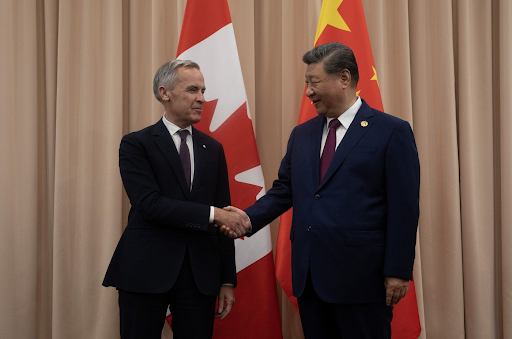
In light of U.S. President Donald Trump’s protectionist trade policies, Canada finds itself seeking alternative trade partners. On January 17, Prime Minister Carney concluded his visit to Beijing, making the first visit to China by a Canadian Prime Minister since 2017 along with meeting with Chinese President Xi Jinping at theAPEC Summit, marking the first formal leader-to-leader meeting between Canada and China since 2017. The meeting came only weeks after Foreign Affairs Minister Anita Anand’s meeting with her counterparts in the People's Republic of China (PRC).
Prime Minister Carney described the meeting as a “turning point” in the relationship, expressing the intention to resolve “outstanding trade issues and irritants,” referring to sensitivities surrounding electric vehicles, agriculture, and agri-food products such as canola and seafood. However, the ‘irritants’ go beyond just those issues. Political frictions between the two nations peaked in 2024, followingCanada’s protectionist measures on various Chinese-manufactured goods.
As Canada takes steps towards re-engagement with the PRC, the government must be cautious in viewing China as a long-term solution to its international economic challenges. While an improved bilateral relationship may present strong commercial opportunities, the PRC has historically shown a tendency to use trade as “currency of power” and “an instrument of punishment” when political friction arises. While recognizing that coexistence is necessary, Canada must find a path that does not compromise its core values of stability, regulated conduct, and responsible partnership.
To understand the current somewhat estranged relationship between Canada and China, it is necessary to review Canadian foreign policy during Justin Trudeau’s decade as Prime Minister.
During the early tenure of Trudeau's Prime Ministership, there was optimism about building stronger ties with China, evidenced by discussions of free trade agreements. Given that his father, Pierre Trudeau, was thefirst PM to establish diplomatic ties with the PRC and supported its entry into the United Nations, Justin Trudeau's later admiration for China’s ‘basic dictatorship’ pointed to an eventual rapprochement with China. However, what began as a trade dispute sparked by China’s objections toCanadian demands during 2017 trade agreement negotiations, as well as Ottawa’s decision to block Chinese acquisition of Canadian construction company Aecon, escalated into diplomatic conflicts following Canada’s arrest of Huawei CFO Meng Wanzhou in December 2018. Canada’s targeted sanctions on China, participation in the Taiwan Strait, restrictions on Huawei and ZTE, and limitations placed on investment by Chinese state-owned companies further set the tone for sour relations in the following years. Tensions would fully ignite in early 2023 with allegations of Chinese foreign interference in Canadian elections, leading to the establishment of the Public Inquiry into Foreign Interference in Federal Electoral Processes and Democratic Institutions. Most recently, a Canadian tariff that is still in effect today was placed on Chinese electric vehicles, illustrating the persistence of frictions in the relationship. However, Trudeau’s resignation in January 2025 has been interpreted by some Chineseinternational relations experts as a turning point, raising hopes that the change in political leadership may offer a chance to ease tensions and soften Ottawa’s anti-China stance.
Carney’s past engagement with China, particularly in his positions at the Bank of Canada, the Bank of England, and the Financial Stability Board, may reflect a business-oriented approach, as well as acritique of protectionist trade policies in bilateral relations. Yet as Canada seeks to address trade issues and irritants in the relationship, it must remain attentive to Beijing’s past behaviour as a trading partner. Any re-engagement must be pursued carefully to ensure that the relationship does not come at the expense of Canada’s values.
Beijing has repeatedly used trade policy to retaliate against Canada. One notable example, as mentioned earlier, was China’s 2019 ban of Canadian Canola imports in retaliation for the detention of Huawei’s CFO, Meng Wanzhou. Although China cited biosecurity concerns, the timing of the trade suspension was widely understood as retaliation. More recently, Chinaimposed 100% tariffson canola oil, meal, and peas, as well as 25% tariffs on pork and seafood products, followingOttawa’s 100% surcharge on Chinese-made EVs and 25% tariff on steel and aluminum products. These retaliatory trade restrictions have often occurred before the harvest season in Canada, resulting in billions in losses for Prairie farmers and exporters.
The PRC’s track record also illustrates a willingness to conduct diplomacy through coercion. The detention of Michael Kovrig and Michael Spavor is a stark example. Their arrests were days after Meng’s arrest under a U.S. extradition order, and were widely understood as “hostage diplomacy" intended to pressure for the release of the Huawei executive. From this, it is evident that Beijing will not refrain from using human lives as leverage. These types of actions are not unprecedented: the PRC have detained Canadian citizens before, and even executed four Canadian nationals earlier this year.
Another reason to adopt a cautious posture is the PRC’s alleged interference with Canadian democratic institutions. The Foreign Interference Commission, in its 2025 report, stated that foreign interference had a significant impact on Canada’s electoral ecosystem in 2019 and 2021. Although foreign interference did not directly shape the election results, it nevertheless influenced the rights of Canadians in the electoral process, freedom from covert influence, and to vote freely in an informed manner. The report also pointed towards an undermining of the public confidence in Canadian democracy, which it describes as the greatest harm Canada has suffered from foreign interference.
Beijing’s growing interest in the Arctic region has further complicated the relationship. Since Xi Jinping declared China a “polar great power” in 2014, Beijing’s Belt and Road Initiative, a global infrastructure project, has expanded its geographical reach to the Arctic. This policy is now referred to as the “Polar Silk Road,” and is an integral part of Chinese foreign policy. This reflects Beijing’s strong economic and strategic interests in the region. For Canada, the Polar Silk Road is significant because it poses a threat to our sovereignty and security. Given the Arctic's vast untapped natural resources, including rare earth elements (REEs) that are crucial for Canada’s current green energy transition, China’s growing investment in the region and near monopoly over REE production and refinement could provide Beijing with strong leverage on Canada.
Climate change has also increased the strategic value of Arctic shipping routes. For example, the melting of Arctic glaciers has allowed the Northern Sea Route (NSR) and the Northwest Passage (NWP) to greatly reduce travel distances and costs. However, Canada considers the NWP to be under its jurisdiction, prohibiting free passage. Yet, Beijing has repeatedly characterized the Arctic as a “common heritage of mankind”, indicating a disregard for Canada's sovereignty. While scientific investments in the Arctic are important for the study of climate change, the Chinese military has used scientific cooperation as a cover for its activities. In the context of persistent Russia-China cooperation in the Arctic in the midst of the Russo-Ukrainian War, the dual-use of Arctic expeditions for military purposes remains an important point in Canadian security considerations.
To conclude, Asia-Pacific policy experts suggest that China views the global turmoil caused by U.S. trade disruptions as a boost in Beijing’s global momentum. Amidst growing U.S. unpredictability, China presents a challenging negotiating partner for Canada, as it wields considerable leverage with its willingness to use economic coercion. Just as Canada has realized its overdependence on the U.S., we must also be careful of over-reliance on China, both because of economic risks and strategic vulnerabilities. During the election debate, PM Carney stated that China was the biggest security threat to Canada, citing foreign interference, its partnership with Russia in Ukraine and its emerging threat to the Arctic. This assertion should be followed up with action and should inform all bilateral engagements with Beijing. While improving relations is desirable, Canada must remain mindful that democracy, security and sovereignty are at stake. Canadian leaders should be cautious of the short-term commercial convenience of China, and focus also on strengthening domestic capabilities and expanding trade with trusted partners in Asia, Australia and the EU.
Edited by Aren Bedros.