
The US Bombs Venezuela in an Attempt to Retaliate Against “War On Drugs”
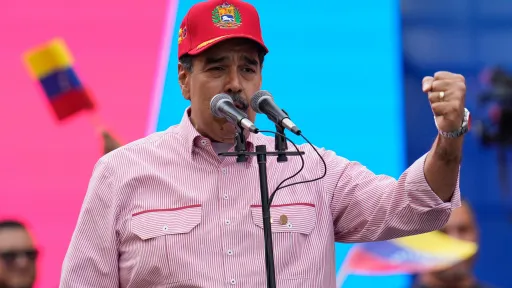
Disclaimer: This article was originally written before the United States’ intervention in Venezuela and the kidnapping of Venezuela’s leader, Nicolas Maduro. He has been transported to New York, where he and his wife were arraigned on charges of narco-terrorism, cocaine importation conspiracy, and possession of machine guns. Maduro and his wife pleaded not guilty. Trump has rejected the idea of backing the democratic opposition in Venezuela led by María Corina Machado, and the US continues to maintain a military presence in the region to pressure remaining Chavista officials to comply with US demands. In justifying the intervention, Trump said US firms would develop Venezuela’s vast oil reserves and recoup allegedly stolen money. Despite the intervention, experts are clear that this event does not mark the end of international law. One expert, Annette Idler, Associate Professor in Global Security at the Blavatnik School of Government, University of Oxford, criticizes the intervention: “Framing the operation as ‘law enforcement’ while deploying military power blurs the line between accountability and aggression, and risks normalising unilateral force.” However, some world leaders are reluctant to speak out against the arrest of a man whose government committed a “grave human rights violation,” according to the UN.
As of right now, the US has its largest military presence in the Caribbean since the 1989 invasion of Panama and uses claims of a “war on drugs” to justify deadly airstrikes. These airstrikes have resulted in 83 deaths, or as the UN calls them: “extrajudicial executions.” According to the Center for Strategic and International Studies, the US Navy already had warships and Coast Guard vessels in the region before this recent military buildup. The surge of forces began in August when the Iwo Jima Amphibious Ready group arrived. This formation included an amphibious assault ship and two amphibious transport dock ships. The military presence then increased in October, when the Pentagon announced it would also deploy the USS Gerald R. Ford, which is the world’s newest and largest aircraft carrier. It arrived on November 11 with more than 4,000 sailors, tactical fighter jets, and accompanying warships. In addition to these two deployments, the US has military bases in Puerto Rico, Honduras, and Cuba with Cooperative Security Locations (CSLs), or surveillance hubs at local airports, in El Salvador, Aruba, and Curaçao. Currently, there is an estimated total of 12,700 US troops present—a figure which analysts consider insufficient for ground invasion.
The US has justified its escalating military presence in the Caribbean by claiming there is a “war on drugs.” Trump’s military campaign began in September, when the US military struck a small open boat allegedly carrying drugs, which killed 11 people. Since then, 21 more vessels in the Caribbean and Pacific have been targeted, increasing the number of killings to 83. The US has since failed to produce any evidence that the targeted vessels were actually carrying drugs, and legal experts say that even if they were, they did not pose an immediate threat. The two survivors of the attacks were returned to their home countries, Ecuador and Colombia, where they face no charges as a result of the US’s failure to produce any evidence. The US Department of State has designated the Cartel de los Soles ( a term referring to high-ranking military officers who had grown rich from drug-running, believed to be led by Maduro) as a terrorist organization, while the Venezuelan military rejected the allegations against Maduro as “a vile lie to justify an illegitimate and illegal intervention in Venezuela.” Christopher Sabatini, a senior research fellow for Latin America at Chatham House says, “This is clearly an attempt to scare Maduro, perhaps into seeking exile, and to push the (Venezuelan) military to overthrow him or force him out, establishing some form of transitional or non-Maduro dominated government.” However, do these attacks by the US comply with international law? Are these attacks necessary or a display of aggression on the US’s part?
UN experts condemn these attacks and refer to them as “extrajudicial execution” by the United States. UN experts say, “International law does not allow governments to simply murder alleged drug traffickers. Criminal activities should be disrupted, investigated, and prosecuted in accordance with the rule of law, including through international cooperation.” US Secretary of State Marco Rubio even indicated that the US could have intercepted the vessel but chose to destroy it to deter the traffickers. UN experts say that under international law, all countries must respect the right to life, even when acting in high seas or in foreign territory. Lethal force should only be used in personal self-defense or the defense of others against a threat to life. The experts also go on to say that the United States’ attack also violates the international law of the sea, which requires criteria to be met in order to intercept ships, and insists on a law enforcement, not military, approach to using force. International law also does not allow the unilateral use of force abroad to fight terrorism or drug trafficking; attacks on organized groups in foreign territory violate the other country’s sovereignty, and could amount to an illegal use of force under the United Nations Charter, as well as customary international law.
The US received additional condemnation from Cuba, which accused the United States of pushing towards the violent removal of Venezuela’s leadership, and warned that the growing deployment of US military forces in the Caribbean represents an “exaggerated and aggressive” threat to regional stability. Cuba’s Foreign Minister Bruno Rodriguez appeals to the people of the United States to “stop this madness,” and cautions that “the US government could cause an incalculable number of deaths and create a scenario of violence and instability in the hemisphere that would be unimaginable.” He also agrees that the actions of the United States breach international law as well as the United Nations charter.
Edited by Kathleen Donnelly.