
Democracy at a Crossroads: The Fallout of Martial Law in South Korea
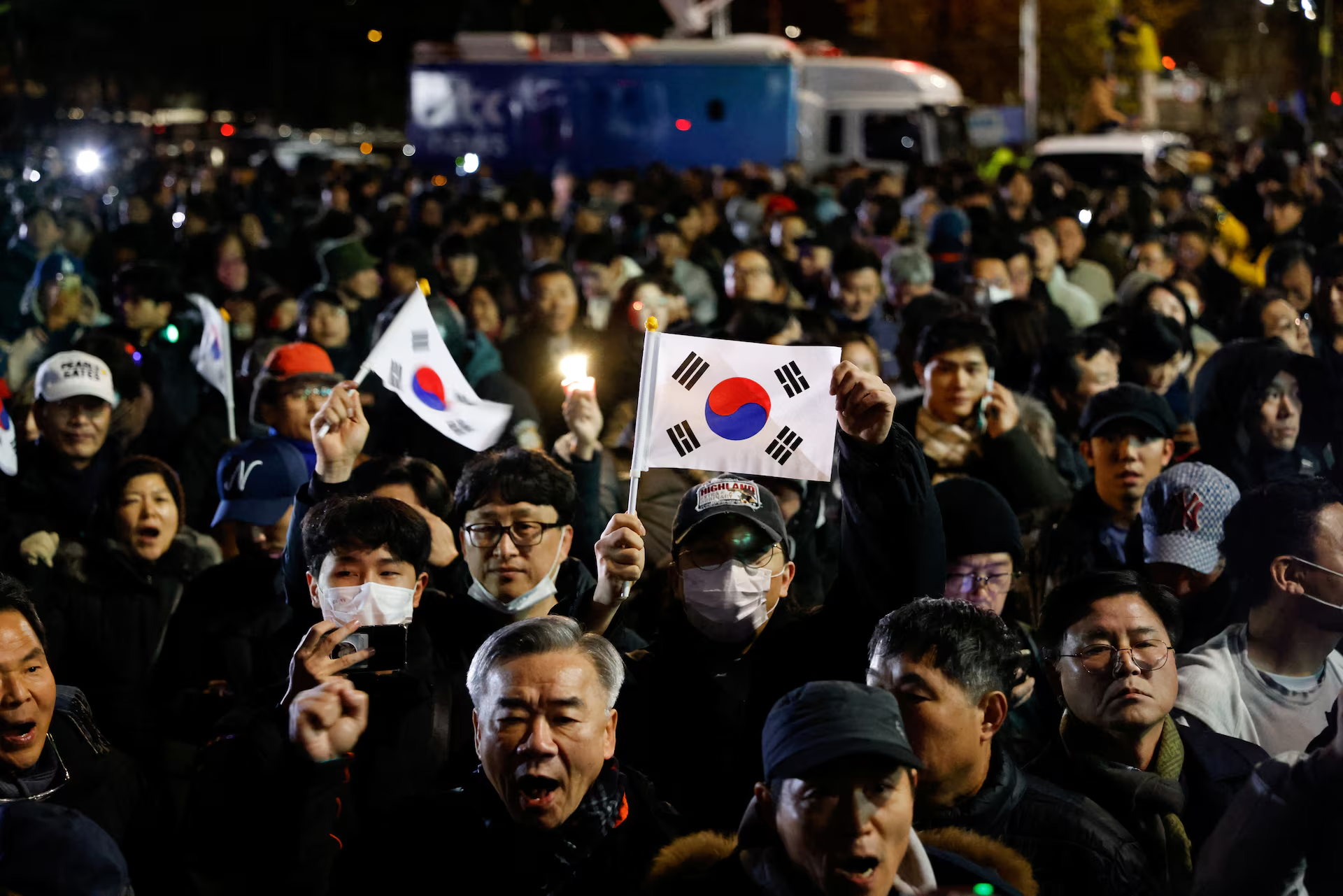
Image of Korean citizens gathering outside the National Assembly of Korea after President Yoon Suk Yeol’s Declaration of Martial Law.
In December 2024, South Korean President Yoon Suk-Yeol made the unprecedented decision to declare martial law, immediately sparking mass protests and international condemnation. This marked the first time martial law had been invoked since the 1980 coup d’état. Yoon justified his decree as a necessary act to preserve democracy amid escalating national security threats. Within hours, the National Assembly convened an emergency session in Seoul, where all 190 lawmakers present voted unanimously to repeal the order. Faced with overwhelming resistance, Yoon rescinded the decree, but the political fallout had already ignited a national reckoning over the future of South Korea’s democracy.
Yoon’s decree granted sweeping powers to the military, effectively banning political activities, restricting media freedoms, and criminalizing dissent—actions that legal scholars argue exceeded constitutional limits. Professor Jang Young-soo of Korea University Law School criticized the order, stating it “did not meet the necessary criteria for such an emergency measure” and lacked legal justification under South Korea’s constitutional framework. While Yoon defended the move as a response to domestic instability, opposition leaders and constitutional experts condemned it as an attack on democratic principles. The swift mobilization of lawmakers, civil society groups, and activists forced the National Assembly to act decisively, leading to the unanimous repeal of the decree. The crisis reinforced the strength of South Korea’s legislative checks and balances but also reshaped the country’s political landscape. Previously fractured opposition parties have now coalesced against what they see as executive overreach, setting the stage for a prolonged battle over presidential authority.
Calls for Yoon’s impeachment quickly followed his failed attempt to impose martial law. By mid-December, the National Assembly passed an impeachment motion, suspending his powers pending a Constitutional Court ruling—a moment widely seen as a turning point in modern South Korean politics. The looming trial, which could permanently remove Yoon from office, has deepened political uncertainty. Further escalating the crisis, key military officials testified that Yoon allegedly ordered security forces to forcibly remove lawmakers attempting to overturn his decree. Meanwhile, factions within Yoon’s own People Power Party have begun distancing themselves from the embattled leader, seeking to restore stability while managing the fallout from his actions.
Beyond the halls of government, Yoon’s declaration of martial law ignited mass protests, with civil society groups, student organizations, and labor unions swiftly mobilizing against what they saw as an existential threat to democracy. Tens of thousands took to the streets in some of the largest demonstrations since the Candlelight Revolution, rallying outside the National Assembly to celebrate the swift repeal of the order while warning that it signaled a dangerous expansion of presidential authority.
The scale of public dissent reflected not just deep mistrust in Yoon’s administration but also broader concerns about democratic backsliding in the region. Comparisons have been drawn to other governments that have used emergency measures to suppress dissent, fueling fears that Yoon’s actions—despite being overturned—could embolden future leaders to test the limits of executive power. While South Korea’s civil society remains among the most active in Asia, activists caution that rapid mobilization alone is not enough; without stronger institutional safeguards, the country remains vulnerable to similar crises.
Media organizations were among the first targets of Yoon’s failed decree, as the martial law order placed news outlets under military supervision, sparking immediate concerns over press freedoms. Although its repeal prevented lasting restrictions, journalists warn that the attempt alone could set a dangerous precedent for future threats to media independence. Once seen as a beacon of press freedom in Asia, South Korea now faces renewed scrutiny over the vulnerability of journalistic autonomy in times of political crisis.
The political instability triggered by Yoon’s martial law declaration has sent shockwaves through South Korea’s economy. Investor confidence plummeted, fueling sharp declines in both the stock market and the national currency as concerns over governance and stability mounted. The Korean Composite Stock Price Index (KOSPI) fell nearly 10% in 2024, a stark contrast to its 19% rise the previous year. Businesses, wary of prolonged leadership uncertainty, have begun delaying major investments and expansions, further dampening economic growth.
Financial markets reacted swiftly: according to Fund Selector Asia, several Korea-focused investment funds saw steep losses within a week of the martial law announcement. The iShares MSCI South Korea ETF dropped 5.36%, while the Barings Korea Trust fell 7.94%. Meanwhile, consumer and business sentiment declined, with companies hesitant to commit to long-term financial plans amid an unstable political environment. If uncertainty persists, South Korea risks capital outflows and slower economic growth in the months ahead.
Foreign investors are increasingly wary of South Korea's political unpredictability. While the nation remains one of Asia’s strongest economies, instability at the executive level raises concerns about policy continuity, trade agreements, and long-term economic planning. A recent survey by the Federation of Korean Industries found that only 12.8% of the country’s top 500 companies plan to increase investments next year, a sharp decline from 16% the previous year. This trend suggests that multinational corporations may begin diversifying their investments to hedge against South Korea’s growing unpredictability, potentially shifting key industries to more politically stable nations in the region.
South Korea’s martial law crisis has echoed beyond its borders, raising concerns among key international allies and testing long-standing partnerships. The United States, South Korea’s most crucial security partner, reaffirmed its commitment to democratic values but remains wary of the political instability caused by Yoon’s actions. Some U.S. policymakers have warned that the crisis could strain military and economic ties, with growing discussions in Washington about contingency plans should instability persist in Seoul. The uncertainty has also prompted Japan and the European Union to reassess their diplomatic strategies, urging South Korea to demonstrate political stability to maintain confidence in trade and security agreements.
China and North Korea have closely monitored the crisis, each seeing an opportunity to advance their strategic interests. According to CNN, “North Korea likes to lampoon South Korea’s democratic system whenever there is tumult in Seoul,” raising concerns that Pyongyang may exploit the political instability for propaganda or military provocations. The North has previously timed weapons tests to coincide with moments of uncertainty, a pattern that could repeat in the wake of Seoul’s crisis.
Meanwhile, Beijing has remained publicly reserved, with its Foreign Ministry stating it has “no comment” on South Korea’s internal affairs. However, Chinese leaders have long opposed Washington’s military presence in the region, and a weakened South Korean government could provide Beijing with new leverage in its ongoing strategic competition with the U.S. As Seoul works to restore political stability, the broader geopolitical consequences remain uncertain.
While the immediate crisis has passed, its long-term consequences remain uncertain. Yoon’s impeachment proceedings will test whether South Korea’s institutions can hold leaders accountable for unconstitutional actions. The political turmoil has also exposed vulnerabilities in the nation’s democratic framework, fueling calls for legal reforms to prevent future abuses of power. Yet, the swift and unified response from lawmakers, civil society, and the public demonstrated the resilience of South Korean democracy. Whether this moment leads to stronger institutional safeguards or deeper political divisions will shape the country’s future for years to come.